



The 2026 Nobel Prize in Physics is going to a scientist who bet that a block of Antarctic ice could be turned into a telescope, and won.
The Royal Swedish Academy of Sciences on Tuesday awarded the prize to Francis Halzen of the University of Wisconsin–Madison “for decisive contributions to the IceCube Neutrino Observatory and the discovery of high-energy neutrinos of astrophysical origin,” according to the academy’s announcement. The award comes with 12 million Swedish kronor.
Chasing ‘ghost particles’
Neutrinos are everywhere, but they almost never interact with anything. They pass straight through the Earth and through our bodies. The academy noted that, unlike other particles, neutrinos travel to us without changing direction or losing energy, so the rare ones produced by extreme cosmic events carry information that cannot be gathered any other way.
The challenge is catching them. Very occasionally a neutrino collides with an atomic nucleus and produces a faint flash of light. Halzen first presented his idea of watching for those flashes in the clear, stable ice at the South Pole in 1988, the academy said. The site is free from many kinds of interference and has no earthquakes.
A cubic kilometer of ice
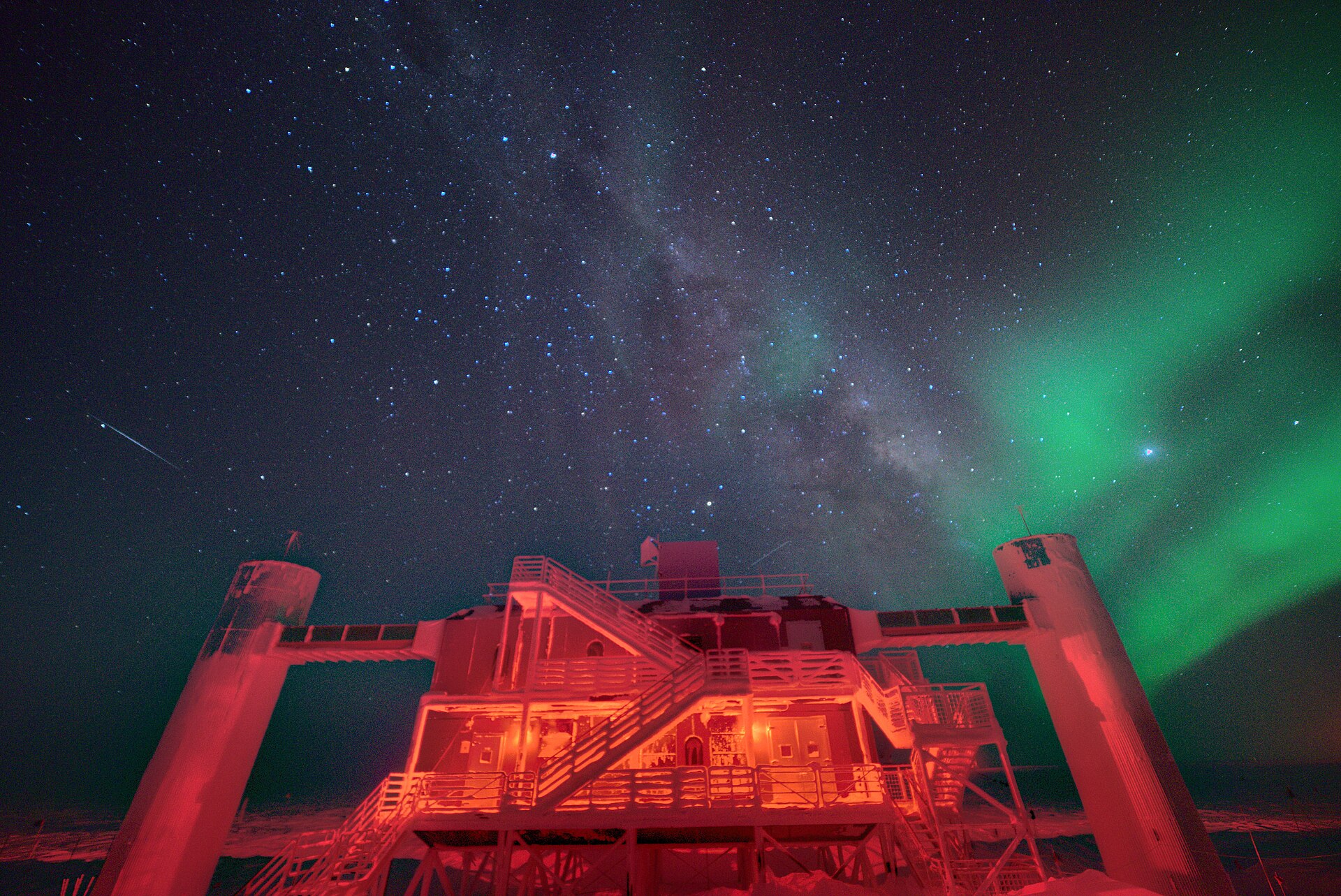
Because high-energy cosmic neutrinos are so rare, the detector had to be enormous. IceCube, finished in 2011, fills a cubic kilometer of ice with thousands of light sensors strung on long cables frozen deep into the ice sheet, the BBC reported. Researchers soon detected the first high-energy neutrinos and later published evidence of neutrinos that came from far beyond the solar system, launching what the Nobel committee called “a new kind of astronomy.”
“Francis Halzen has led an international team of researchers and engineers who have provided us with a fantastic instrument. His tenacity and scientific vision has paved the way for a new kind of astronomy,” said Mark Pearce, chair of the Nobel Committee for Physics.
‘How lucky I was’
At a news conference, Halzen said he was surprised his idea worked so well. “I have to emphasise how lucky I was. Because when we started this project, everybody realised this was maybe a good idea, but very few thought it would work, including myself,” he said, according to the BBC.
Halzen was born in 1944 in Tienen, Belgium, earned his doctorate from KU Leuven in 1969 and is a professor at UW–Madison, according to the Nobel Foundation.
What comes next
The academy said the neutrino data IceCube continuously collects should reveal more about the violent settings where these particles are born and could even uncover previously unknown cosmic phenomena. Among the observatory’s results is an image of the Milky Way built from neutrinos rather than light, the BBC noted.
This year’s Nobel Prize announcements continue through the rest of the week.
Photo: John Hardin via Wikimedia Commons (CC BY 4.0). The IceCube Laboratory at the South Pole under the winter night sky, August 2021.
Sources: NobelPrize.org press release; BBC News.
This article was produced with AI assistance and is based on reporting from NobelPrize.org press release and BBC News.