



BELGRADE — Serbian President Aleksandar Vučić resigned Sunday, cutting short his second term to seek the prime minister’s office in snap parliamentary elections on Oct. 25 — a vote that will test his grip on power after nearly two years of student-led protests over corruption and accountability.
Vučić delivered the announcement from the presidential palace in Belgrade, where supporters gathered outside. “I am resigning as president,” he said, according to AFP and other outlets. “Tomorrow morning I will hand over my duties to the parliament speaker.”
Parliament Speaker Ana Brnabić, a longtime Vučić ally and former prime minister, becomes acting president for up to three months. Under Serbia’s constitution, a presidential election must be called within that window, meaning voters are expected to cast ballots twice before year’s end.
From station disaster to national movement
The political crisis traces to Nov. 1, 2024, when a concrete canopy collapsed at the renovated railway station in Novi Sad, killing 16 people. Public anger over what many saw as corruption and corner-cutting in the project grew into some of Serbia’s largest demonstrations since the fall of Slobodan Milošević in 2000, at times drawing hundreds of thousands into the streets.
Students, teachers, workers, and farmers pressed for a transparent investigation and, later, early elections. Vučić’s Serbian Progressive Party (SNS) has dominated politics since 2012; he has served as prime minister or president since 2014. Barred from a third presidential term, he is now heading the SNS list as its candidate for prime minister — a post that is formally more powerful than the presidency, though Vučić long exercised outsized influence from either office.
Earlier this month he called the Oct. 25 parliamentary vote, citing “major turbulence on the domestic political scene.” He had signaled in June that he intended to resign and contest that ballot.
Pardons and the road to the polls
Minutes before resigning, Vučić used his constitutional powers to pardon 49 people, including 23 connected to protest-related cases — a mix of students and party loyalists, he said, tied to “the terrible events we have gone through over the past year and a half,” according to Serbian public broadcaster RTS and international reports.
The Oct. 25 contest pits SNS against a student-backed anti-corruption list known as “Students Win,” backed by several opposition parties, and a pro-Western coalition often described as European Serbia, among others. Analysts and local observers say the student movement could pose Vučić’s most serious challenge in more than a decade; some polls show a tight race, though methodologies are hard to verify independently.
Vučić has rejected accusations that his government bears responsibility for the problems highlighted by protesters. He has framed his resignation as a choice to “compete as an ordinary man,” and told CNN hours before stepping down that he would acknowledge the results if the opposition won.
Why it matters beyond Belgrade
Serbia, the largest country in the Western Balkans by population and economy, sits at a geopolitical crossroads — seeking EU membership while maintaining ties with Russia and attracting Chinese investment. Democratic backsliding and Belgrade’s refusal to join Western sanctions on Moscow over Ukraine have stalled EU talks. Regional analysts say a shift — or a contested result — in Serbia could ripple into Bosnia and Herzegovina, Montenegro, Kosovo, and Croatia.
For now, the calendar is set: parliamentary elections Oct. 25, an interim presidency under Brnabić, and a presidential vote required within three months of Vučić’s resignation. Whether Sunday’s departure marks a real opening or a strategic repositioning will be decided at the ballot box.
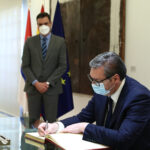
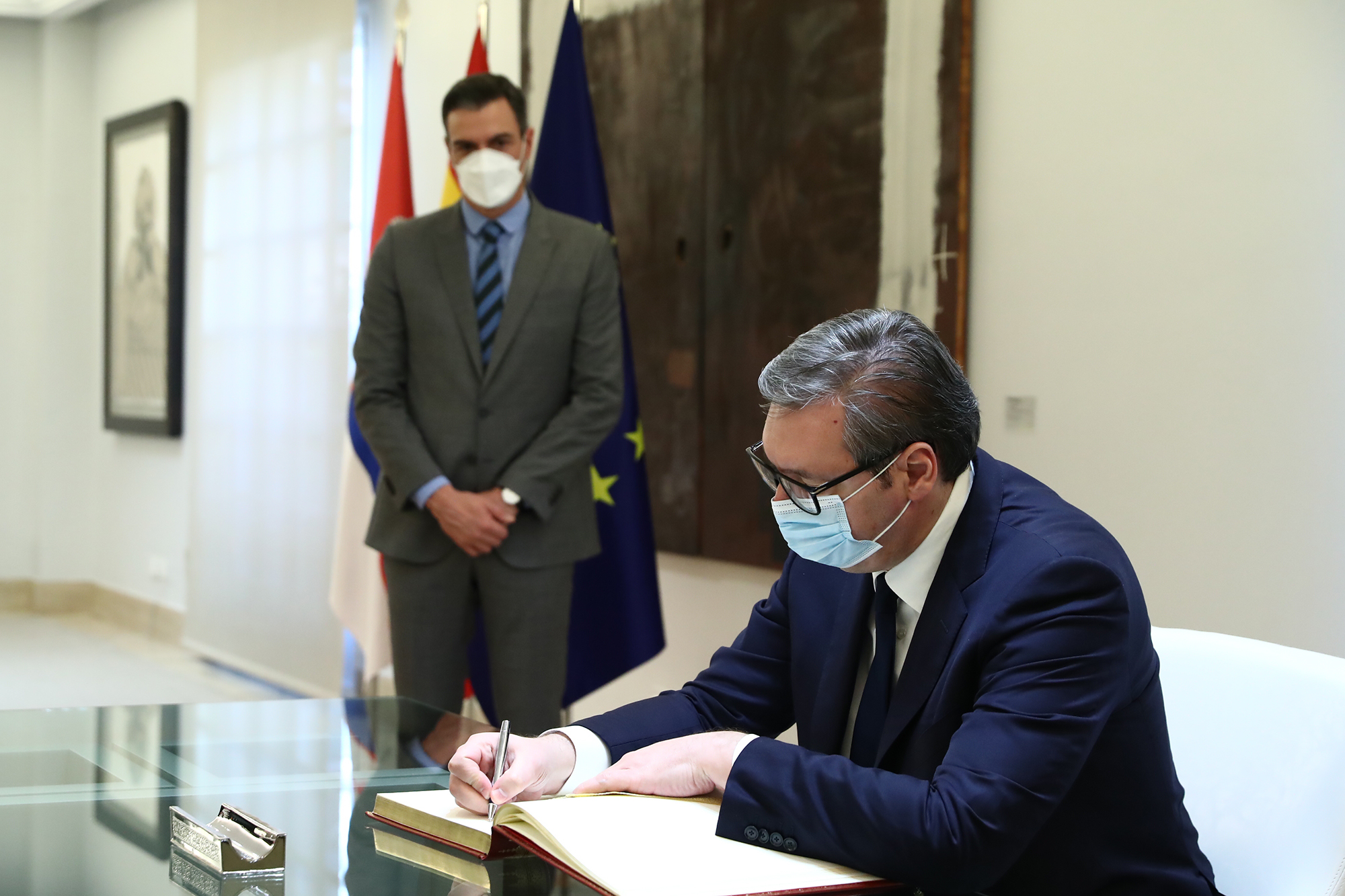
Featured image: Aleksandar Vučić (right) with Spanish Prime Minister Pedro Sánchez at La Moncloa Palace, Madrid, Feb. 23, 2022. Photo by Fernando Calvo Rollán / Ministry of the Presidency, Government of Spain. Via Wikimedia Commons (Attribution license).